.jpg)



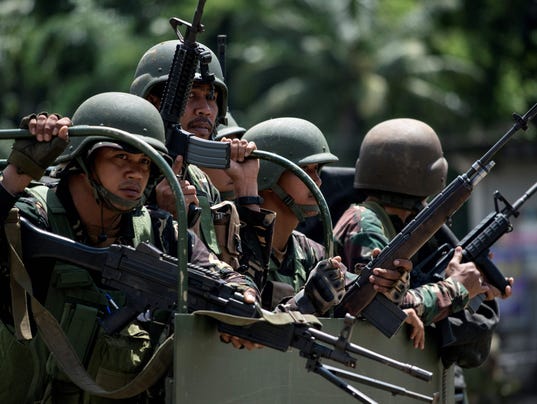
The Philippines has become the epicenter of ISIS expansion into Southeast Asia, a region where over 60 groups have pledged allegiance to the extremist group, according to the Singapore-based International Centre for Political Violence and Terrorism Research.
While ISIS has lost ground in Syria and Iraq, the group has been clear about its intentions to turn to Southeast Asia as one of their major sites for operations, drawing recruits from the Philippines and the Muslim-majority countries of Indonesia and Malaysia.
Historically, Al Qaeda has had links to extremist groups in Southeast Asia, but ISIS has been connected to a number of more recent attacks, such as a suicide bombing that killed three police offers at a bus station in Jakarta in May and a bombing in the Philippine city of Davao in September last year that killed 14.
For some analysts, the drawn-out siege in Marawi is exposing the vulnerability of the Philippine military to answer the threat, which could undermine the regional security balance.
“I think Marawi is showing the absolute limits of what the armed forces of the Philippines is capable of,” said Zachary Abusa, professor of national security strategy and a Southeast Asia expert at National War College in Washington, D.C. “After years and years of U.S. counter-terrorism assistance, I think we should be very concerned.“
The United States began the U.S. Joint Special Operations Task Force-Philippines (JSOTF-P), to assist Philippines counter-terrorism efforts in 2002 but ended the operation in 2015.
On Saturday, the U.S. Embassy in Manila acknowledged that U.S. special forces are assisting the Philippine military in the ongoing fight to retake Marawi. A Philippine military spokesman said the help was limited to surveillance and technical support.
The Philippines has become a destination for militants from around the region, analysts say, especially after a video released by ISIS in June 2016 advised potential recruits to head for Mindanao — the southern Philippine island where Marawi is located — if they couldn’t make it to Syria or Iraq.
“The Philippine groups actually control territory,” said Abusa. “There's just been this slow and steady trickle of foreigners into Mindanao the past few years.”
Dozens of foreigners have been fighting alongside the Filipino militants in Marawi, with several Malaysians and Indonesians as well as a Chechen, Yemeni and Saudi among those reported killed.
At the Shangri-La Dialogue, a regional security forum held in Singapore last weekend, defense ministers from around Southeast Asia expressed alarm about the rise of terrorism in the region and pledged closer cooperation, especially in conducting coordinated sea patrols in the Sulu Sea between Malaysia, Indonesia and the Philippines.
Singapore’s defense minister Ng Eng Hen called terrorism the region’s “biggest security concern.”
He told a roundtable discussion that the Philippines is becoming a magnet for extremists: "All of us recognize that if not addressed adequately, it can prove a pulling ground for would-be (extremists) who can launch attacks from there.”
At the same conference, Indonesian minister of defense General Ryamizard Ryacudu said there were around 1,200 ISIS operatives in the Philippines, including 40 from Indonesia.
“The terrorism threat in this region has evolved into an unprecedented immediate level of emergency,” he told the conference. “The death group’s area of operation has gone global.”
In 2016, ISIS officially recognized Isnilon Hapilon, the leader of a faction of the Abu Sayyaf (ASG) militant group, as leader of its Southeast Asia regional operations, and has vowed to create a wilayat, or Islamic State province, in Mindanao.
Hapilon was the target of the botched military raid that triggered a siege by Abu Sayyaf militants and the Maute group, which has also pledged allegiance to ISIS, in Marawi on May 23. Hapilon is on the FBI’s Most Wanted Terrorists list, with a $5 million reward for his capture.
In an attack, some 500 militants seized large parts of the city while burning buildings, cutting power and communications lines and taking hostages. The fighting has so far left 58 security forces, 20 civilians and around 138 militant fighters dead. The ISIS-linked militants still control parts of the central city and have as many as 2,000 hostages, according to the Philippine military.
Philippine President Rodrigo Duterte declared martial law in Mindanao on May 24, citing the rising threat of ISIS.
“We are in a state of emergency,” Duterte said. “I have a serious problem in Mindanao and the ISIS footprints are everywhere."
Rohan Gunaratna, head of the International Centre for Political Violence and Terrorism Research in Singapore, said that the Philippines has long underestimated the threat that ISIS posed.
“They didn't understand what (ISIS) wants. (ISIS) is not an operation-based group — (ISIS) is a state-building group. (ISIS) wants to capture and control territory and govern territory.”
Marawi has finally placed ISIS on center stage in both the Philippines and the rest of the region, Gunaratna said.
“You can say Marawi is a game changer in the fight against terrorism in this region,” he said. “Because it demonstrated to all the countries in the region what (ISIS) can do. They thought this business of running cities is something in the Middle East — they never thought it could happen in Asia.”